

Introduction to Ethiopia
Located in the Horn of Africa, Ethiopia is the tenth largest country of Africa. It is a a very diverse territory where high mountains and plateaus on the West leave space to deserts and tropical forests in the East and South. With an estimated population of more than 130 million inhabitants, it is also the most populous country of the continent, with a large young population, 50% of its citizens being aged less than 19. This is due to a historical high fertility rate, though declining, in the last decades: from over 7 births per woman in the 1960s-1980s to approximately 4 in 2023.
Ethiopia’s economy has maintained relatively fast growth in recent years, but it faces rising macroeconomic and social pressures. Continuing a long-run pattern of growth above 5% annually, real GDP growth was about 6.5% in 2023, yet high inflation—around 21% in 2024 and still in double digits at the end of 2025—has eroded purchasing power and complicated macro management. The structure of output remains heavily agrarian, with agriculture contributing roughly 35% of GDP in 2024, while manufacturing and services gradually expanded around it. At the same time, conflict, drought, and reform-related shocks have pushed poverty back up: the share of the population living below 3 USD a day (2017–2021 PPP) rose from about one‑third in 2016 to nearly 39% in 2021, and is projected to reach the low‑40% range by 2025.
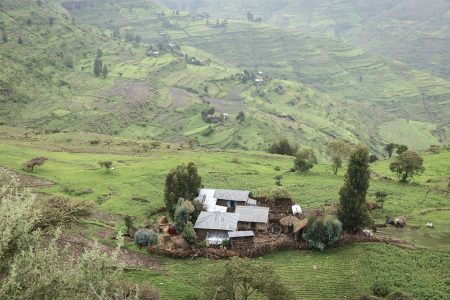
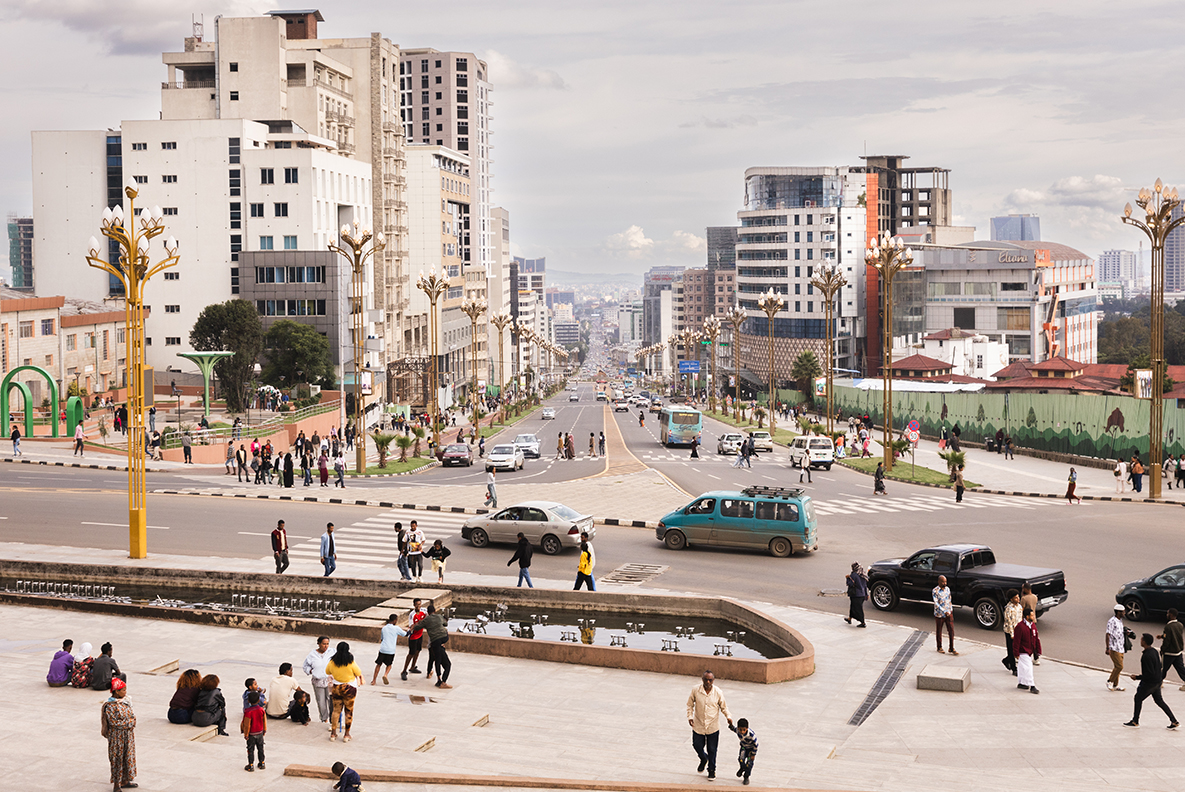
This is reflected in strong disparities of available services including healthcare, infrastructures, electricity, water and sanitation access, and education opportunities between rural and urban areas. In 2024, still 76% of the population was residing in rural areas (World Bank, 2025), often isolated from urban major centers and lacking infrastructure and economic opportunities supporting individual and family development.
Ethiopia is also characterized by a regional-ethnic composition where cultural traits are strongly related to geographical regions, and which are the center of many armed conflicts in the region and in the country itself.
In August 2025, we travelled with photographer Gaia Squarci and professor Negash Mulatu to Debre Birhan, a relatively safe small city at the center of a vast rural area in the Oromia region, 130 km north east of Addis Ababa, to support the research project RESILIENCE led by the University of Naples.
The research study investigates how electricity, labour, education and climate shocks interact in rural Ethiopia. Our field trip on the ground confirmed many of the findings of the paper but it gave as well a unique perspective on the reality on the ground of sometimes cold statistics and data.
Debre Birhan, a highland city about 130 kilometres north‑east of Addis Ababa, offered a natural laboratory: a place connected to the national grid, surrounded by villages that ranged from fully electrified kebeles to homes relying on small solar panels or still living entirely by kerosene, candles and biomass. Our ten‑day trip—moving from the lit streets of the city to mixed‑status villages like Etege and on to darker settlements such as Woynye, Tikur Gedel and Atakit—was designed to meet the families behind the regression tables, and to document with interviews and photographs how electricity, or its absence, shapes children’s work, study, and sense of the future.
Date:
17 Marzo 2023
ethiopia
References
Distributive politics and economic growth.
The quarterly journal of economics , 109(2), 465-490 1994
Occupational choice and the process of development.
Journal of political economy , 84(2), 755-776 1993
Inequality does cause underdevelopment: Insights from a new instrument.
Journal of development economics , 84(2), 755-776 2007
On the impact of inequality on growth, human development, and governance.
International Studies Review , 24(1), viab058 2022
Income distribution and macroeconomics.
The review of economic studies , 60(1), 35-52 1993
Alternative theories of distribution.
Review of Economic Studies 23 , 94–100. 1956
Capital accumulation and economic growth.
In: Lutz, F.A. Hague, D.C. (Eds.), The Theory of Capital. St. Martin's Press, New York 1961
Is inequality harmful for growth?
American Economic Review , 84: 600-621 1994
World Development Report 2006: Equity and Development.
Washington, DC: World Bank 2006